Home / Resources / The STR Cleaning Blueprint
The STR Cleaning Blueprint™ · Published & stewarded by Rinsebase

Clean is an activity.
Guest-ready is a state.

Most cleaning companies run on one person's memory. The codes, the quirks, the price you should have charged, the standard you'd recognize but never wrote down — all of it lives in the owner's head, and the business can only grow as far as that head can reach. The STR Cleaning Blueprint™ is the profession written down: 427 pages, 13 chapters, and 109 operating tools that take a cleaning company from its first property to multiple markets.

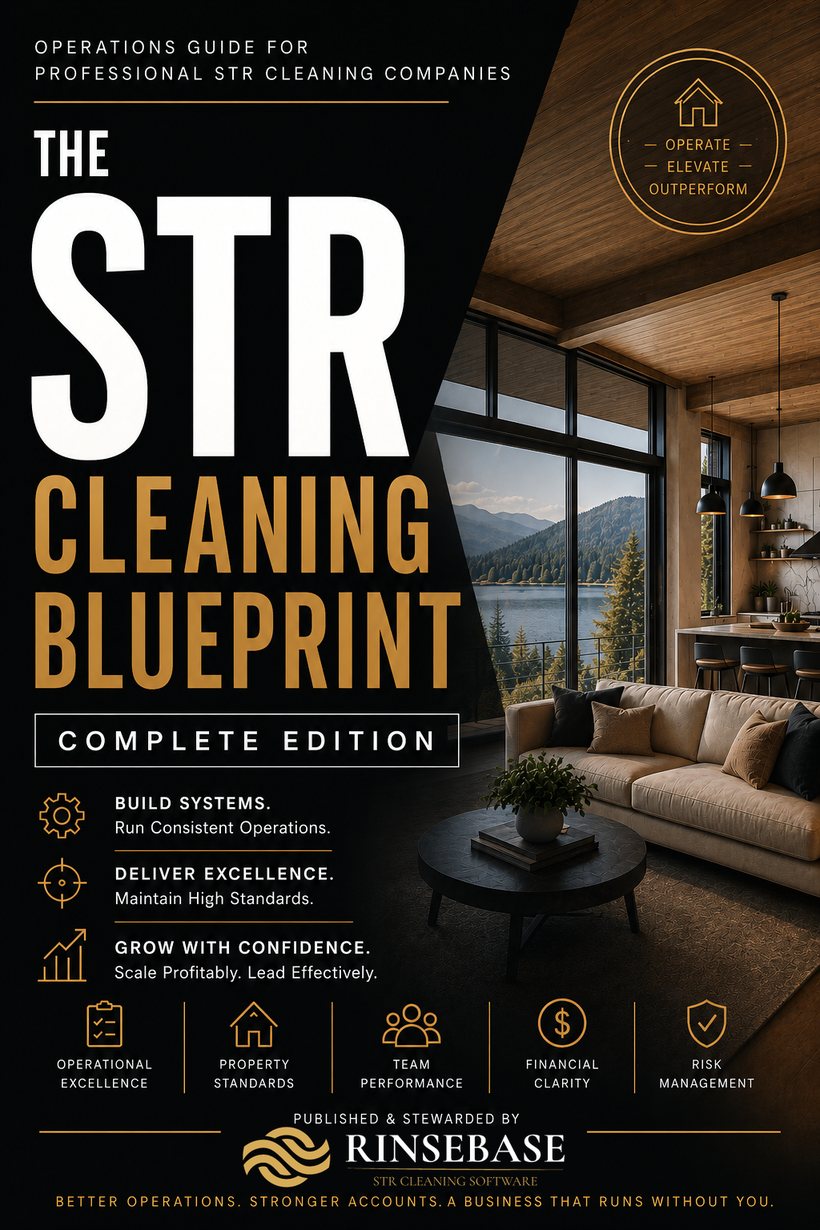
Cover of The STR Cleaning Blueprint, Complete Edition — the operations guide for professional STR cleaning companies, published and stewarded by Rinsebase
Chapters
13
First property → multiple markets
Pages
427
Complete Edition
Operations Vault™
109
Editable Word & Excel tools
Price
Free
Handbook and Vault
The one idea

A spotless clean can still produce
a failed guest arrival.

If you take one thing from the handbook, take this: cleaning is an activity, but guest-ready is a verified operating state. A property is not ready because the visible tasks are done. It is ready when it has been prepared, checked, documented, and communicated for the next arrival.

That distinction is not academic. It changes how a company prices, schedules, trains, inspects, communicates, chooses software, and grows. It is the difference between a business that sells hours and a business that sells reduced operational risk — which is what hosts and property managers are actually buying.

Chapter 1 · Understanding the IndustryThe STR Cleaning Blueprint™
Opening — The property was clean, but it was not ready

A spotless clean can still produce a failed guest arrival

The cleaner arrived shortly after the departing guest left. She followed the checklist, changed every bed, scrubbed the bathrooms, vacuumed the floors, wiped the kitchen, and staged the property carefully. Four hours later, the home looked excellent. She locked the door, sent a quick message that she was finished, and drove to the next job.

Two hours later, the property manager called. The arriving guest was standing outside with luggage. The entry code did not work. The backup key was missing. The batteries in the smart lock had failed, and no one had tested the lock before leaving. Inside the property, the thermostat had been turned off, the refrigerator was warm, and the cleaner had not noticed that the previous guest had damaged a bedroom window latch.

The home was clean. The operation had failed.

To the guest, there was no meaningful difference between a dirty bathroom and a front door that would not open. Both communicated the same message: this property was not ready for my arrival.

Guests do not experience cleaning, maintenance, access, supplies, and communication as separate departments. They experience one arrival.
Sample excerpt · Chapter 1Page 13 of 427

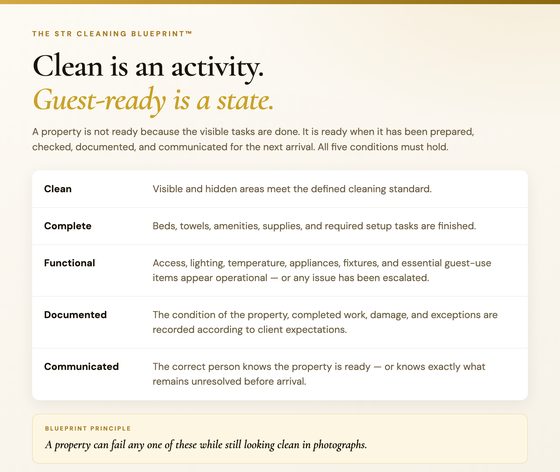
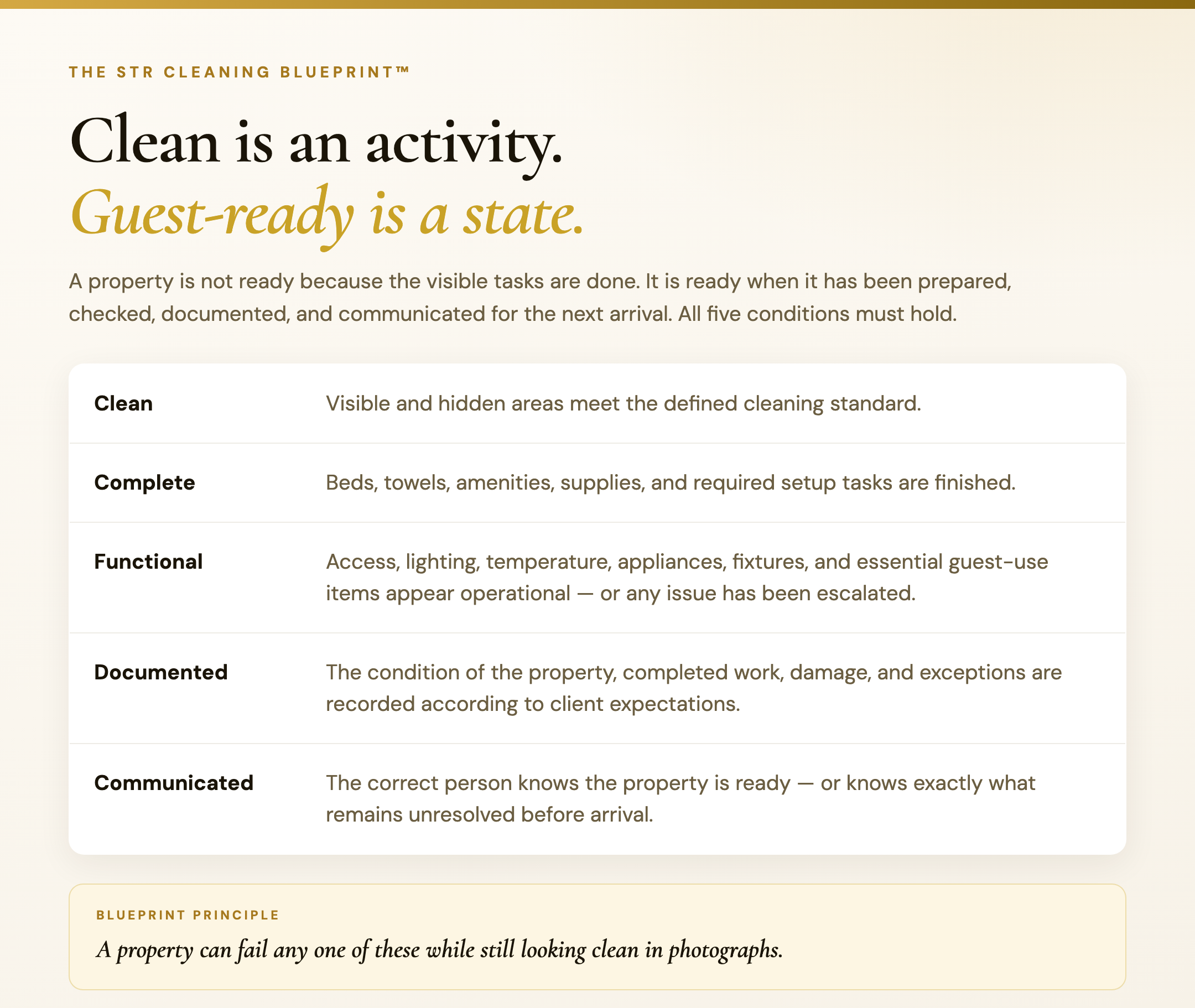
The five conditions of a guest-ready property

A property can fail any one of these while still looking clean in photographs. This is why mature operations use property-specific standards, completion procedures, quality checks, and escalation rules rather than relying on memory or personal judgment alone.

ConditionWhat it means
CleanVisible and hidden areas meet the defined cleaning standard.
CompleteBeds, towels, amenities, supplies, and required setup tasks are finished.
FunctionalAccess, lighting, temperature, appliances, fixtures, and essential guest-use items appear operational — or any issue has been escalated.
DocumentedThe condition of the property, completed work, damage, and exceptions are recorded according to client expectations.
CommunicatedThe correct person knows the property is ready — or knows exactly what remains unresolved before arrival.
Blueprint Principle Learn before you scale. The purpose is not to move faster. It is to understand enough to make the next decision intelligently. Growth built on misunderstanding becomes expensive very quickly.
Sample framework · Chapter 6

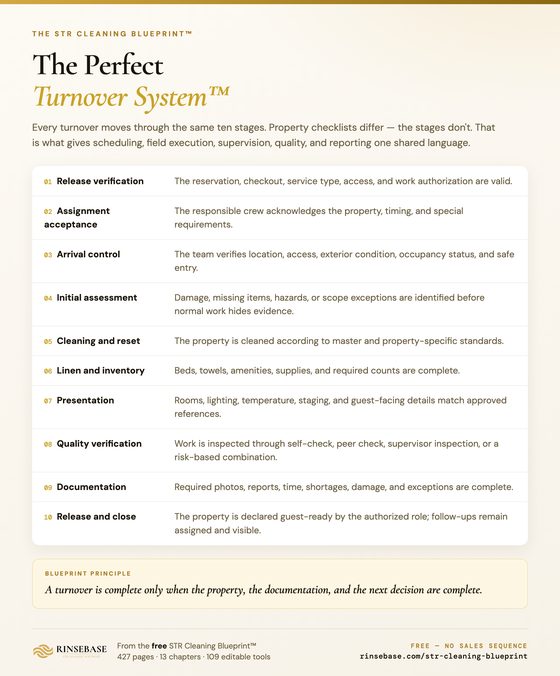
The Perfect
Turnover System™

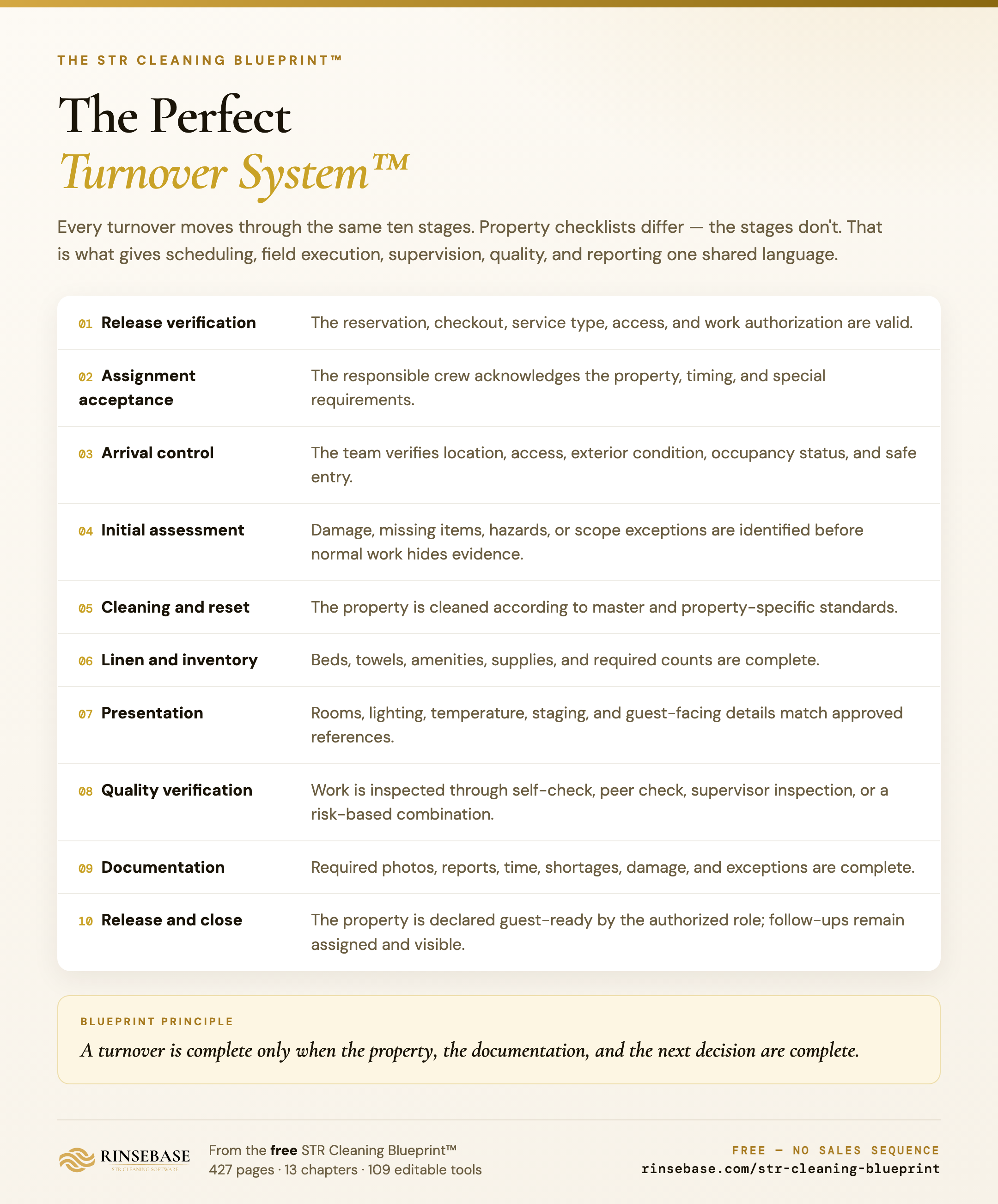
Every turnover should move through a standard operational path. Property-specific checklists differ, but the major stages stay consistent — which is exactly what gives scheduling, field execution, supervision, quality, reporting, and software workflow a common language.

StageRequired outcome
01 Release verificationThe reservation, checkout, service type, access, and work authorization are valid.
02 Assignment acceptanceThe responsible crew acknowledges the property, timing, and special requirements.
03 Arrival controlThe team verifies location, access, exterior condition, occupancy status, and safe entry.
04 Initial assessmentThe team identifies excessive condition, damage, missing items, maintenance, hazards, or scope exceptions before normal work hides evidence.
05 Cleaning and resetThe property is cleaned according to master and property-specific standards.
06 Linen and inventoryBeds, towels, amenities, supplies, and required counts are complete.
07 PresentationRooms, furnishings, lighting, temperature, staging, and guest-facing details match approved references.
08 Quality verificationThe work is inspected through self-check, peer check, supervisor inspection, or a risk-based combination.
09 DocumentationRequired photos, reports, time, shortages, damage, and exceptions are complete.
10 Release and closeThe property is declared guest-ready by the authorized role; follow-up items remain assigned and visible.

The stages exist to prevent premature closure. A cleaner finishing physical cleaning does not automatically mean the property is guest-ready. Linen may still be in transit. An inspector may require correction. A damage report may need escalation. The final status should represent the full promise, not one person's portion of it.

Blueprint Principle A turnover is complete only when the property, the documentation, and the next decision are complete.
How to use it

You don't read it cover to cover.
You enter at your stage.

The handbook covers the full arc of a professional STR cleaning company — from the first property to multiple markets. Find the description that fits you today and start there. Each chapter solves a distinct operating problem, so you can enter at your stage and read forward.

Chapters 1–4
Preparing to start, or serving your first property
Understanding what "guest-ready" really means, and building a legitimate, protected company.
Chapters 5–8
Serving your first accounts
Onboarding properties, running reliable turnovers, and defining your quality standard.
Chapters 9–10
Building a team and taking on larger clients
Hiring and developing people, and partnering with property managers.
Chapters 11–13
Leading an organization across one or more markets
Building the organization, scaling it under control, and choosing its direction.
Professional Standard The standard is the same at every size. What changes as you grow is the level of formality, not the level of professionalism. A one-page checklist and an enterprise system can both meet the standard.
The handbook

Thirteen chapters.
One running company.

A single running example — Summit Cleaning Solutions, the property manager North Shore Vacation Rentals, and the people and properties around them — carries through the entire book, maturing chapter by chapter so every idea lands in real operating context.

01Guest-ready, not just clean · The Foundation Chapter
Understanding the STR Cleaning Industry
You are not simply starting a cleaning business. You are building an operations company that supports the hospitality industry — where a spotless clean can still produce a failed guest arrival if the property is not truly ready.
  • 01What guest-ready really means
  • 02How the STR ecosystem works
  • 03The professional operator's role
  • 04Opportunities, pressures & risks
  • 05Readiness & the operating mindset
3 Vault tools
02Build before the first customer · The Formation Chapter
Building Your Company
Readiness does not require knowing every future answer. It requires resolving the decisions that must be settled before a customer depends on you — the legal, financial, insurance, equipment, and brand foundations of a real business.
  • 01Business structure & legal setup
  • 02Insurance & financial foundations
  • 03Equipment & supplies
  • 04Brand & professional identity
  • 05Readiness before the first job
6 Vault tools
03Earn the right first accounts · The First Accounts Chapter
Winning Your First Customers
Your first customers are not won by sounding bigger than you are. They are won by being prepared, credible, responsive, and useful — and by choosing the right first accounts rather than the largest.
  • 01What customers are really buying
  • 02Finding & qualifying fit
  • 03Discovery & the first conversation
  • 04Pricing the proposal
  • 05Handling objections with VALUE
7 Vault tools
04Price that pays for the work · The Pricing Chapter
Pricing for Profit
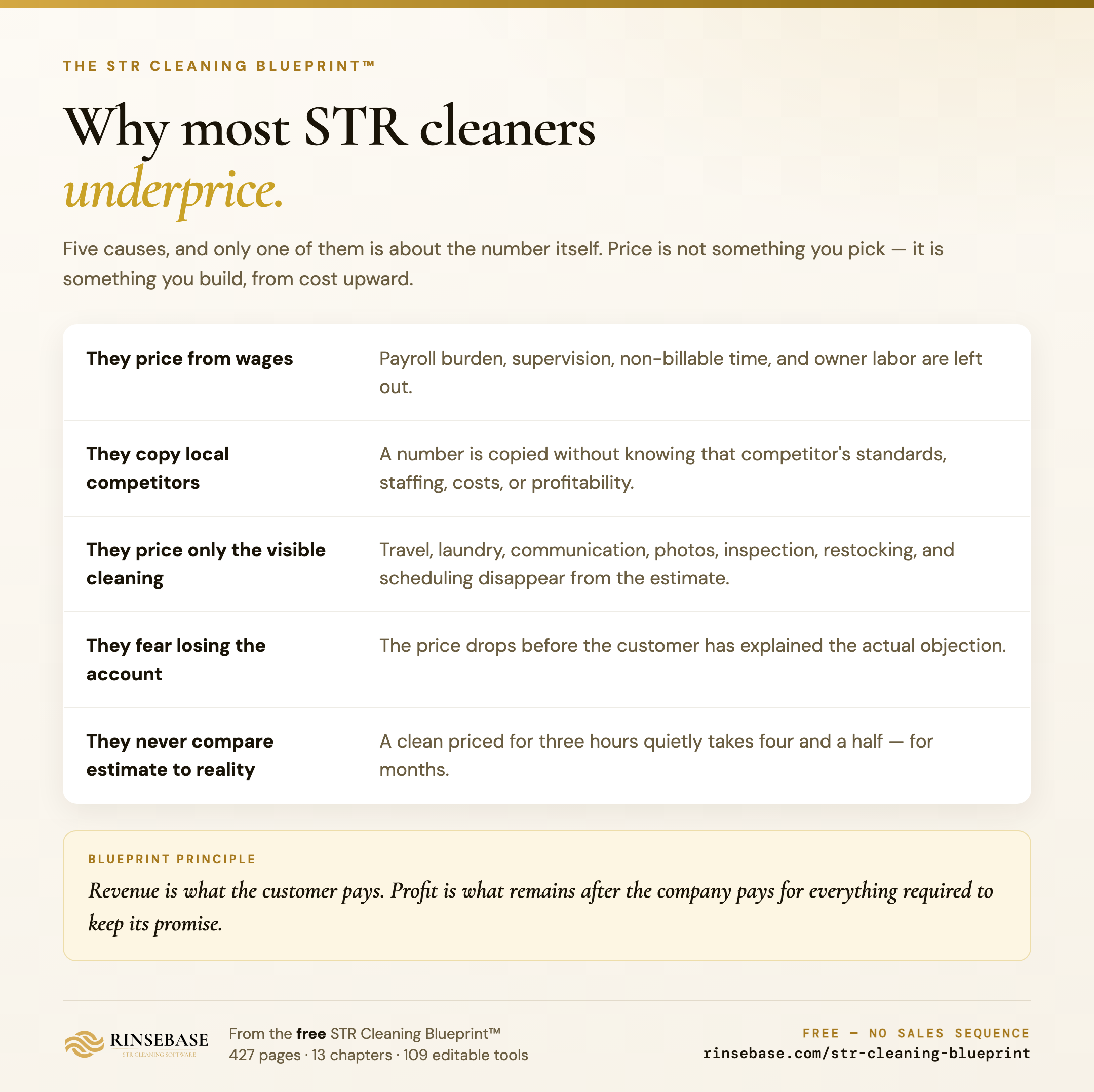
Price is not a number you pick — it is a number you build. It must recover burdened labor, overhead, and risk, and still leave margin to reinvest, or the busiest company can quietly work its way toward failure.
  • 01The true cost of a turnover
  • 02Burdened labor & overhead
  • 03Building the price up
  • 04Margin, risk & reinvestment
  • 05Presenting price with confidence
5 Vault tools
05The foundation for every property · The Onboarding Chapter
Property Onboarding
Onboarding is not the short administrative gap between signing a customer and the first clean. It is the controlled process of learning how a property must operate and turning that knowledge into standards the whole team can execute.
  • 01Why onboarding is an operating process
  • 02The Property Knowledge Book™
  • 03Access, standards & readiness
  • 04The first-clean readiness gate
  • 05Stabilizing the account
6 Vault tools
06A system that repeats every day · The Operating-System Chapter
Daily Operations
Daily operations are where promises meet reality. Consistency does not come from working harder each morning — it comes from a repeatable operating system that moves the right work, information, and decisions to the right people on time.
  • 01The Perfect Turnover System™
  • 02Scheduling & the daily plan
  • 03Communication & decision rights
  • 04Handling disruption
  • 05Measuring daily performance
7 Vault tools
07A repeatable guest-ready standard · The Quality Chapter
Cleaning Standards & Quality
Guests do not evaluate the effort behind a turnover — they evaluate the result. Quality is not a feeling or a final glance; it is a written standard, verified the same way every time, defended by inspection, evidence, and root-cause discipline.
  • 01What quality means in STR
  • 02Writing standards, not preferences
  • 03Layered inspection & calibration
  • 04Photos as operational evidence
  • 05Defects, root cause & corrective action
11 Vault tools
08The supply system behind every turn · The Supply-System Chapter
Laundry & Inventory Management
The most visible failure in short-term rentals is usually the least visible system: linen and supplies. Par levels, laundry capacity, and inventory discipline decide whether a fully-prepared day quietly runs out of towels.
  • 01Linen as an operating system
  • 02PAR levels & the linen lifecycle
  • 03In-house vs outsourced laundry
  • 04Inventory & par management
  • 05The economics of the supply chain
11 Vault tools
09A workforce that holds the standard · The People Chapter
Hiring & Team Development
A company can only deliver what its people can execute. Hiring, training, qualification, and development are the systems that convert individual effort into a dependable standard — so the operation no longer relies on founder heroics.
  • 01Roles & the hiring standard
  • 02Structured training & qualification
  • 03Verification & certification
  • 04Retention & development
  • 05Reducing founder dependence
11 Vault tools
10One operating system · The Partnership Chapter
Working with Property Managers
A property-management account is not a collection of cleaning jobs. It is a shared operating system connecting two companies — and it succeeds only when scope, information, authority, execution, economics, and governance are deliberately aligned.
  • IProperty managers are operating partners
  • IIShould you take this account?
  • IIIDiscovering & launching the portfolio
  • IVDesigning shared operations
  • V–IXInformation, economics, governance & growth
11 Vault tools
11An organization that outlives the founder · The Organization Chapter
Building a Professional Organization
A professional organization is intentionally designed to produce excellent outcomes through leadership, people, systems, and culture — rather than through the extraordinary individual effort of a founder who can still see every problem.
  • IWhy organizations matter
  • IILeadership & structure
  • IIISystems & knowledge
  • IVCulture & capability
  • VThe organization that outlives you
9 Vault tools
12Many accounts, markets & teams · The Scale Chapter
Scaling the Professional Organization
Scale is not simply more work. It is coordination — the discipline that keeps cost, rework, and confusion from rising faster than revenue as a company takes on multiple large accounts, markets, and management layers.
  • IWhat scale really demands
  • IIMulti-account coordination
  • IIIMulti-market operations
  • IVGovernance at scale
  • VContinuity & resilience
11 Vault tools
13Choose what to become · The Strategy Chapter
Strategic Direction & Business Vision
Strategy is the discipline of choosing what to become and allocating capital, leadership, and capacity toward it — so a company shapes its future deliberately instead of drifting wherever the next large account happens to pull it.
  • IStrategy for a cleaning company
  • IIThe founder's strategic transition
  • IIIOpportunity & portfolio choices
  • IVAllocating capital & capacity
  • VThe enduring organization
11 Vault tools
The Operations Vault™

109 tools that turn judgment
into daily operations.

Every chapter points to the Operations Vault™ — the worksheets, calculators, forms, registers, and completed examples that make the chapter's thinking executable on a Tuesday. DOC tools are editable Word documents. XLS tools are working Excel models with the math already built.

Ch. 1 — Understanding the Industry 3 tools
  • DOCBusiness Planning Worksheet
  • XLSSTR Industry Readiness Assessment
  • DOCStartup Checklist
Ch. 2 — Building Your Company 6 tools
  • DOCBrand Identity Worksheet
  • DOCBusiness Formation Checklist
  • DOCEquipment and Chemical Starter List
  • DOCFirst Customer Readiness Path
  • DOCInsurance Coverage Checklist
  • XLSStartup Budget
Ch. 3 — Winning Your First Customers 7 tools
  • DOC30 Day First Customer Plan
  • DOCDiscovery and Qualification Guide
  • DOCIdeal Customer Profile
  • DOCOutreach Kit
  • DOCPositioning Statement Builder
  • DOCProposal and Objection Kit
  • XLSSales Pipeline Tracker
Ch. 4 — Pricing for Profit 5 tools
  • XLSEstimated vs Actual Review
  • XLSException, Travel & Laundry Pricing
  • DOCPricing Policy and Review Worksheet
  • DOCQuote and Price Presentation Kit
  • XLSTurnover Price Builder
Ch. 5 — Property Onboarding 6 tools
  • DOCAccess and Property Risk Plan
  • DOCDiscovery and Onboarding Workbook
  • DOCFirst Clean Readiness Gate
  • XLSOnboarding Tier and Cost Planner
  • DOCProperty Knowledge Book™
  • DOCStabilization Review and Change Log
Ch. 6 — Daily Operations 7 tools
  • DOCCommunication and Decision Rights Matrix
  • DOCDaily Operations Playbook
  • XLSDaily Operations Scorecard
  • DOCDisruption Response Guide
  • DOCOperations Platform Evaluation Guide
  • DOCPerfect Turnover System™ Checklist
  • XLSTurnover Priority and Crew Board
Ch. 7 — Cleaning Standards & Quality 11 tools
  • XLSApproved Chemical and Dwell Time Register
  • DOCClient Quality Review and 90 Day Plan
  • XLSDefect and Rework Record
  • DOCGuest Ready Bathroom Standard
  • DOCGuest Ready Standard and Library
  • DOCHigh Touch Disinfection Protocol (SAN-01)
  • DOCPhoto Shot List Builder
  • XLSQuality KPI Dashboard
  • DOCRisk Based Inspection and Calibration
  • DOCRoot Cause and Corrective Action
  • DOCSelf Inspection and Supervisor Audit
Ch. 8 — Laundry & Inventory 11 tools
  • XLSConsumable Reorder Calculator
  • DOCInventory Maturity Assessment
  • XLSLaundry Capacity Model
  • XLSLinen Lifecycle Replacement Planner
  • DOCLinen Release Standard and Quarantine Log
  • XLSMake or Buy Break Even
  • XLSMaterial Readiness Dashboard
  • DOCPack Specification Library and Storage Map
  • DOCPeak Day Disruption Playbook & Safety SOP Index
  • XLSProperty Linen Calculator and PAR Planner
  • DOCRoute Manifest, Chain of Custody and Transfer
Ch. 9 — Hiring & Team Development 11 tools
  • XLSCandidate Scorecard
  • DOCCoaching, Corrective Action, Promotion and Retention
  • XLSCompetency Matrix
  • DOCOnboarding Checklist and 30 Day Training Plan
  • DOCRealistic Job Preview
  • DOCRole Design Worksheet and Profiles
  • DOCStructured Interview Guide and Reference Check
  • DOCTechnician Qualification Standard and Observation
  • DOCTrainer Guide, Calibration and Competency Ladder
  • XLSWorkforce Capacity Planner and Labor Cost Stack
  • XLSWorkforce KPI Dashboard
Ch. 10 — Working with Property Managers 11 tools
  • XLSAccount Profitability Review
  • DOCCommunication Escalation Map and Issue Classification
  • DOCDiscovery Questionnaire and Implementation Plan
  • DOCGovernance Maturity, Corrective and Exit
  • XLSImplementation Cost and PM Pricing Worksheet
  • DOCLaunch Readiness Gate and Pilot Selection
  • DOCPM Qualification and Opportunity Assessment
  • XLSPM Scorecard
  • XLSPortfolio Capacity Test and Concentration Risk
  • DOCResponsibility and Approval Authority Matrix
  • DOCScope of Services and SLA Planning Guide
Ch. 11 — Building a Professional Organization 9 tools
  • DOCCoaching Model Guide — Developing Judgment
  • XLSCompetency Ladder Organizational Assessment
  • DOCDecision Rights Matrix
  • DOCLeadership Pipeline Worksheet
  • XLSOrganizational Culture Review
  • DOCOrganizational Memory and Continuity Planner
  • DOCProfessional Organization Model and Built Twice
  • DOCResponsibility Map and Escalation Planner
  • XLSSaturday Morning Test and Founder Dependence
Ch. 12 — Scaling the Organization 11 tools
  • DOCAuthoritative Systems, Data Governance and Continuity
  • XLSEnterprise Capacity and Concentration Review
  • XLSMulti Unit Scorecard
  • DOCNonnegotiable Core and Adaptable Edge Matrix
  • DOCOperating Unit Charter and Unit Basis
  • DOCReplication Launch, Integration and Stop/Hold/Reverse
  • DOCScale Control Model and Multi Unit Responsibility Map
  • XLSScale Readiness and Maturity Assessment
  • DOCShared Service Agreement Template
  • XLSSpan of Control and Management Load Review
  • DOCThree Levels of Control and Cross Unit Escalation
Ch. 13 — Strategic Direction & Vision 11 tools
  • DOCBusiness Vision Roadmap and Commitment Charter
  • XLSCapital Allocation and Reserve Planner
  • XLSLeadership Attention Budget
  • DOCNow / Next / Not-Yet / Not-Us Decision Board
  • DOCRisk Reversibility Portfolio and Stop Decisions
  • DOCStewardship, Renewal, Succession and Vision Renewal
  • DOCStrategic Assumption Register
  • DOCStrategic Direction Worksheet and Alignment
  • XLSStrategic Measures and Milestone Scorecard
  • XLSStrategic Opportunity Test and Full Cost Model
  • DOCStrategic Review Guide and Decision Record
Get the Blueprint

The whole handbook.
The whole Vault. Free.

We could have sold this. We decided not to. This industry has spent a decade being told it's "just cleaning" — by software built for plumbers, by platforms that treat the cleaning company as a vendor seat, and by pricing models that charge you more every time a client adds a property. The fastest way to change that is to put the professional standard in every operator's hands and let the work speak.

Send me the Blueprint

The complete 427-page handbook plus all 109 Operations Vault™ tools — editable Word documents and working Excel models. One email, no drip campaign you can't leave.

That doesn't look like a complete email address — mind checking it?

Free forever. No card, no account required. We'll email you the handbook and the Vault, and Todd reads every reply.

On its way.

Check your inbox — the handbook and the full Operations Vault™ are landing now. If it hasn't arrived in a few minutes, look in spam and mark it safe, or just reply to info@rinsebase.com and Todd will send it by hand.

Software-neutral by design

The standard doesn't need us.
Running it at scale is another matter.

The Blueprint is written to be executed on paper, in spreadsheets, or on a platform — that is deliberate, and it is why the handbook names no software in its standards. A one-page checklist and an enterprise system can both meet the standard.

What changes with volume is the cost of holding it together by hand. Somewhere past a few dozen properties, the Property Knowledge Book™ stops fitting in a binder, photo evidence stops being findable, and the ten stages of a turnover start living in a group text. That is the problem Rinsebase was built for — and it's the same handbook underneath:

The Property Knowledge Book™ becomes the property record. Access, quirks, standards, linen specs, and per-property checklists live on the property, not in someone's memory — and reach the crew on the job.
Photos become operational evidence. Camera-only capture, EXIF validation, and GPS proximity — so Chapter 7's "photos as evidence" is a verifiable record instead of a text-message attachment.
Release and close is a real gate. Guest-ready is a status an authorized role sets — not an assumption made when the vacuum goes back in the car.
The PM partnership gets its own surface. Chapter 10's shared operating system as a branded portal your property-manager clients log into — live status, photo proof, per-property history.

Rinsebase is priced by crew, never per property — starting at $19/month — so growing a portfolio doesn't grow your software bill.

See the PlatformPricing
Todd Schaffer, Founder of Rinsebase
Why we wrote it

"My wife works in this industry. I watched an entire profession get treated as unskilled labor by people who had never once stood in a property with two hours until check-in. Every standard in this handbook exists because somebody learned it the expensive way. Putting it behind a paywall would have been the wrong move."

— Todd Schaffer
Founder, Rinsebase · USMC Veteran
Common questions

Blueprint FAQ

What is the STR Cleaning Blueprint? +
The STR Cleaning Blueprint™ is a 427-page professional handbook for the short-term-rental cleaning industry, published and stewarded by Rinsebase. Thirteen chapters carry a cleaning company through the full arc of the business — from understanding the industry and building the company, through pricing, property onboarding, daily operations, quality standards, laundry and inventory, and hiring, to property-manager partnerships, professional organization, scale, and strategic direction. It ships with the Operations Vault™: 109 worksheets, calculators, checklists, and SOPs that turn each chapter's judgment into daily operating tools.
What does guest-ready mean in short-term rental cleaning? +
Cleaning is an activity, but guest-ready is a verified operating state. A property is not ready because the visible tasks are done; it is ready when it has been prepared, checked, documented, and communicated for the next arrival. The Blueprint defines five conditions that must all hold: clean, complete, functional, documented, and communicated. A property can fail any one of them while still appearing clean in photographs.
How much does the STR Cleaning Blueprint cost? +
The handbook is free to read. The standards, frameworks, and chapter material are published openly because the industry is better when the standard is shared. The Operations Vault™ — the 109 editable Word and Excel tools — is free to download with an email address.
Who is the STR Cleaning Blueprint for? +
Professional short-term-rental cleaning companies at every stage. The handbook is organized so you can enter at your stage rather than read cover to cover: chapters 1–4 if you are preparing to start or serving your first property, chapters 5–8 if you are serving your first accounts, chapters 9–10 if you are building a team and taking on larger clients, and chapters 11–13 if you are leading an organization across one or more markets.
Do I need Rinsebase to use the Blueprint? +
No. The Blueprint is written to be software-neutral — the standard is the same whether you run it on paper, in spreadsheets, or on a platform. What changes as you grow is the level of formality, not the level of professionalism. Rinsebase publishes and stewards the handbook, and Rinsebase is built to execute what it describes, but every chapter stands on its own.
What is the Perfect Turnover System? +
The Perfect Turnover System™ is the Blueprint's ten-stage path that every turnover moves through: release verification, assignment acceptance, arrival control, initial assessment, cleaning and reset, linen and inventory, presentation, quality verification, documentation, and release and close. Property-specific checklists differ, but the stages stay consistent — which is what gives scheduling, field execution, supervision, quality, and reporting a common language. Its purpose is to prevent premature closure: a cleaner finishing physical cleaning does not automatically mean the property is guest-ready.

Stop being the only person
who knows how it works.

Take the handbook and the Vault — they're yours, free. Then, when holding it together by hand starts costing more than it saves, come see what it looks like running on a platform built for exactly this.

Get the Blueprint — FreeStart Free — 14 Days, No Card

427 pages · 13 chapters · 109 Operations Vault™ tools · Published & stewarded by Rinsebase